SwipeReport/Reviews/RSVP Australia

RSVP Australia review (2026)
Tested by Alex Mercer in Melbourne, April 2026. 30-day trial.
SwipeReport score
74/100
Verdict
Better match quality and higher response rates than most apps. The Stamp model is confusing at first, and RSVP refuses to show you what anything costs until after you've created an account.
Matches (30 days)
43
Response rate
61%
Suspicious profiles
4 / 180 browsed
Support response
3 hrs 40 mins
Works well for
- Serious relationship seekers
- 30s and above
- Anyone exhausted by swipe apps
Less suited to
- Casual dating
- Under-30s (thin user base)
- People who want pricing upfront
RSVP launched in 1997. It's older than most of the people using it, which is either reassuring or slightly unsettling depending on how you feel about that. What it means practically: the user base skews older, the intent skews serious, and the whole model runs differently from swipe-based apps.
I tested it for 30 days in Melbourne. Here's what I found.
How it actually works
Every other dating app you've used runs on swiping. RSVP doesn't. You view full profiles, use a "Wink" to show interest, and if someone winks back you can start a conversation. The catch: starting a conversation yourself requires a Stamp, which costs money. Not a subscription. A per-conversation credit.
New users find this confusing. You sign up for free, browse, wink, and then hit a wall when you try to message anyone first. It's not hidden, exactly, but it's not explained well either.
Once I got my head around it, I could see what it actually does. Someone who's paid to contact you is more invested than someone who swiped right while watching TV. My response rate was 61% across the 30 days, the highest I've recorded on any platform. Whether that's the Stamp model filtering for intent or just the type of people who use RSVP, it's real.
The Stamp system, explained plainly
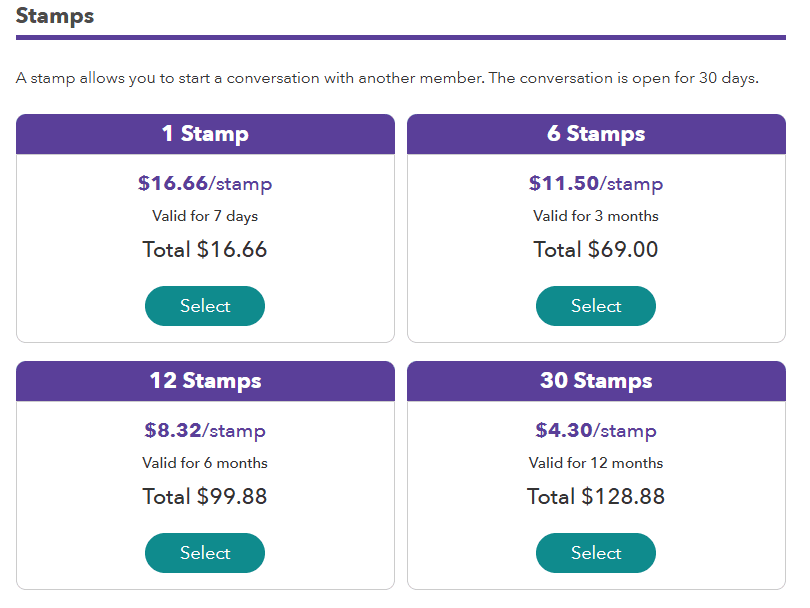
A Stamp opens a conversation with one person for 30 days. You can buy them individually or get a monthly allowance through a premium subscription. Here's what they actually cost:
| Pack | Cost per stamp | Total | Valid for |
|---|---|---|---|
| 1 stamp | $16.66 | $16.66 | 7 days |
| 6 stamps | $11.50 | $69.00 | 3 months |
| 12 stamps | $8.32 | $99.88 | 6 months |
| 30 stamps | $4.30 | $128.88 | 12 months |
That 7-day validity on a single stamp is worth paying attention to. If you buy one, use it within the week or it's gone. It's the worst value option by a significant margin and I'd avoid it unless you're specifically testing the platform before committing.
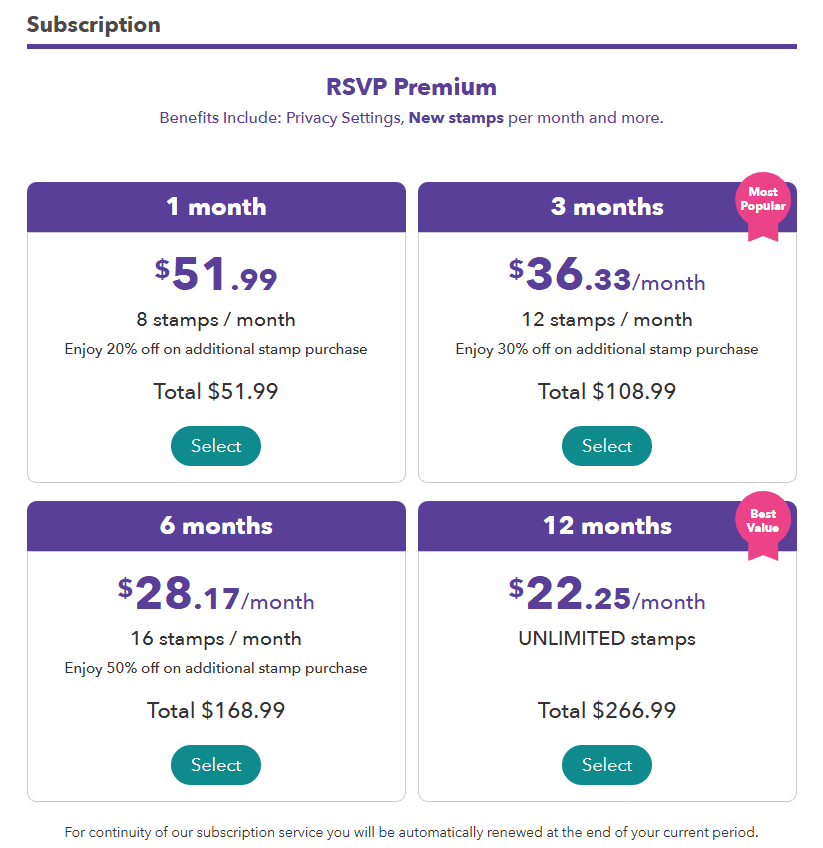
Premium subscriptions include a monthly stamp allowance and are a better deal if you're using the platform seriously:
| Plan | Monthly cost | Total billed | Stamps included |
|---|---|---|---|
| 1 month | $51.99 | $51.99 | 8 per month |
| 3 months | $36.33 | $108.99 | 12 per month |
| 6 months | $28.17 | $168.99 | 16 per month |
| 12 months | $22.25 | $266.99 | Unlimited |
The 12-month plan at $22.25/month with unlimited stamps is the only tier where cost stops being a factor in who you contact. At $51.99/month for 8 stamps, the monthly plan works out to $6.49 per conversation started. That's fine if your conversations go somewhere. Less fine if half of them don't reply.
One thing to know before you commit: stamps expire if you cancel your subscription. The cancellation flow itself is three clicks in settings, which is reasonable. But losing unused stamps with no refund is the kind of thing that generates complaints on ProductReview, and it should be more visible before you pay.
RSVP dating cost in Australia: short answer
Stamps start at $16.66 single and drop to $4.30 each in the 30-pack. Premium subscriptions range from $51.99 a month down to $22.25 on the 12-month plan, where Stamps become unlimited. Browsing and Winks stay free. Sending an actual message requires a paid Stamp. All AUD, all 2026 prices verified on the live RSVP site.
How RSVP browsing works (without Stamps)
Browsing on RSVP is free. You sign up, fill in a profile, and search the full member base. You can view profiles, see photos, and send a Wink to register interest, all without spending anything. The paywall sits on actual messaging. A Stamp unlocks a real conversation with one specific person for 30 days.
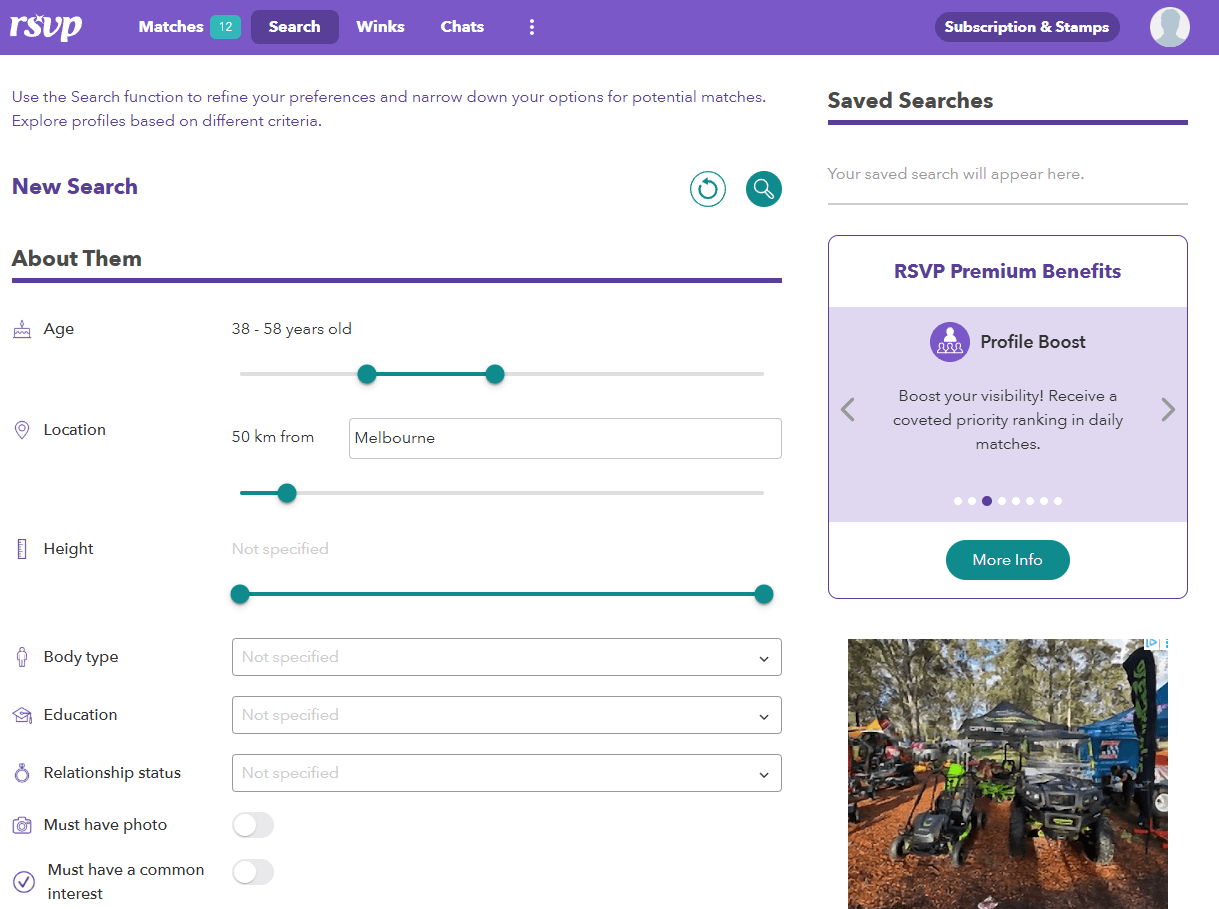
The search filters do the standard work: age, location, distance, height, kids, smoking, drinking. Sort by "last active" if you want to skip the long-dormant accounts. The pool has been running since 1997 and there are legacy profiles in it.
Where you are changes what free browsing turns up. Browsing RSVP in Melbourne fills several pages of active over-30s profiles, so you can afford to set a tight distance filter and still have plenty to look through. Browsing in Perth is a different exercise: the WA pool is smaller and skews male, so women get replies faster and men are better off widening the distance filter to Perth-wide before they spend anything. Either way, set your distance, sort by last active, and you get an honest read on who is actually around in your city before a Stamp is on the line.
What browsing doesn't tell you is whether the person you Winked at has Stamps to spend. A profile can look active by sign-in date but still be unable or unwilling to reply because they haven't bought a Stamp pack. That's the structural friction with RSVP's model. Free browsing creates the appearance of activity, the paid layer is where intent actually shows up.
The pricing transparency problem
None of the above pricing is visible before you create an account. You sign up, build a profile, and only then see what things cost.
Most people searching "how much does RSVP cost" are trying to decide whether to sign up at all. RSVP's approach means you hand over your email address and personal details before they answer that question. The prices aren't unreasonable once you see them. The fact that you can't see them without signing up is a deliberate friction pattern, and it's the main reason the pricing transparency score is as low as it is.
My 30-day test in Melbourne
Standard test setup: consistent photo set and bio across all platforms I test. Melbourne, 30 days. Results:
- 43 matches over 30 days
- 26 conversations started with Stamps
- 61% response rate on those conversations
- 4 suspicious profiles flagged out of roughly 180 browsed
- Support query answered in 3 hours 40 minutes
43 matches sounds low compared to Tinder or Hinge. It isn't, once you factor in quality. These are people with completed profiles, many of whom have paid to be active. The conversations that started actually went somewhere. On Tinder I'd get 200 matches and talk to maybe 15% of them. On RSVP, 61%.
The fake profile rate was the lowest I've recorded. RSVP manually reviews every uploaded photo before it goes live, which takes up to 24 hours but does real work. The 4 profiles I flagged were vague rather than obviously fake. All of them had the usual tells: generic bio, location that didn't match the stated distance, early messages trying to move off the platform.
Where RSVP works across Australia
RSVP at rsvp.com.au is national, but the active pool concentrates in the larger east-coast cities. My 30-day test was in Melbourne, where the over-30s pool is the strongest I've seen on any AU dating site bar eHarmony.
Sydney has the largest absolute pool of any RSVP city, with the broadest age spread. Perth is smaller but the male:female ratio skews male, so women generally get faster responses. Brisbane is mid-sized and steady, with good representation in the 30-45 bracket. Adelaide is the thinnest of the capitals on RSVP, viable but expect longer gaps between meaningful matches.
The UX problem
RSVP's website looks like it was designed in 2014 and patched rather than rebuilt. It works, but it doesn't feel modern next to Hinge or Bumble. The app is better but still behind.
The terminology is genuinely confusing if you're new to the platform. I watched someone in their late 40s try RSVP for the first time and they couldn't work out what a Wink did, what a Stamp was, or what a SuperWink added on top. They're not a slow person. The onboarding just doesn't explain any of it. It's a fixable problem and 27 years in, it hasn't been fixed.
Score breakdown
| Category | Score | Why |
|---|---|---|
| Profile authenticity | 19/25 | Manual photo review keeps obvious fakes low |
| Match quality | 21/25 | Serious intent skew produces better conversations |
| UX and features | 14/20 | Website feels dated, app is better but still behind competitors. Stamp system takes two or three visits to fully understand. |
| Pricing transparency | 8/15 | Doesn't show prices before you sign up |
| Safety features | 12/15 | Blocking, reporting, and photo approval all solid |
| Total | 74/100 |
Compared to Tinder and eHarmony
Tinder is volume. RSVP is intent. I got 43 matches on RSVP and had real conversations with most of them. My last 30-day Tinder test produced over 200 matches and roughly the same number of actual conversations. Pick which problem you'd rather have. RSVP also topped our ranking of the best Australian dating sites, ahead of the other four platforms I tested.
Against eHarmonyit's closer. Both target serious relationships, both have older user bases, and both hide their pricing before you sign up. eHarmony's matching is more prescriptive; RSVP gives you more control. The practical difference is that RSVP has been running in Australia for 27 years. In the 30-50 bracket, most cities have more active RSVP users than eHarmony users. That matters more than which algorithm is technically better.
Who is RSVP dating worth it for?
If you're 30 or older and want a relationship rather than something that fizzles after two weeks, RSVP is worth testing. The Stamp model filters for people who are at least somewhat serious, and the match quality reflects that.
If you're under 30, the user base is thin and you'll feel it. If you want casual dating, the whole platform is designed around the opposite intent.
And if the pricing opacity bothers you before you even sign up, that's a reasonable position. It bothers me too.
RSVP dating questions
Is RSVP free to use?
Browsing and profile creation are free. You can view full profiles and send Winks without paying. Sending an actual message requires a Stamp, which starts at $16.66 for a single Stamp or works out cheaper in 6, 12, or 30-packs. Receiving messages is always free.
How much do RSVP Stamps cost in 2026?
Single Stamp $16.66 (valid 7 days). 6-pack $69 ($11.50 per Stamp, valid 3 months). 12-pack $99.88 ($8.32 per Stamp, valid 6 months). 30-pack $128.88 ($4.30 per Stamp, valid 12 months). Premium subscriptions also include a monthly Stamp allowance and unlimited Stamps on the 12-month plan.
Is RSVP still active in 2026?
Yes. RSVP is operated by RSVP.COM.AU Pty Ltd per the current site copyright and has run continuously since 1997. The active user base is smaller than the 2010s peak but still meaningful for over-30s, particularly in Sydney and Melbourne. Reddit threads through 2024 consistently mention it as one of the established AU dating sites alongside eHarmony.
How does RSVP compare to eHarmony Australia?
Both target serious dating but the models differ. eHarmony uses a long compatibility questionnaire and a yearly subscription. RSVP uses search-and-filter and pay-per-message Stamps. eHarmony hides photos behind the paywall, RSVP shows them for free. Full head-to-head on the dedicated comparison page.
How much is RSVP membership?
Premium subscriptions: monthly $51.99 (8 Stamps), 3-month $43.32/month (10 Stamps), 6-month $34.65/month (15 Stamps), 12-month $22.25/month (unlimited Stamps). All AUD, all 2026 prices. Stamps can also be bought outside a subscription from $16.66 single up to $128.88 for a 30-pack.
Last reviewed 24 July 2026. Originally tested in Melbourne (Tier 1), April 2026. Profile authenticity, match quality, pricing, and support were all personally verified during a 30-day test period. Pricing tables re-verified against rsvp.com.au May 2026. July 2026 update: browse-by-city detail added to the free-browsing section covering how the Melbourne and Perth pools differ. June 2026 refresh: cost-summary H3 using the exact "RSVP dating cost in Australia" phrase, a Where-RSVP-works-across-Australia H2 covering Sydney, Perth, Brisbane and Adelaide alongside the Melbourne test, and a How-much-is-RSVP-membership FAQ entry.