SwipeReport/Compare/eHarmony vs RSVP
eHarmony or RSVP: which one fits Australian relationship-seekers in 2026?
Tested by Alex Mercer in Melbourne, April-May 2026. 30 days on each platform.
TL;DR
RSVP scored 74/100 in our 30-day Melbourne test. It delivered 43 matches, a 61% response rate, and a fake profile rate low enough not to be a serious problem. It costs less than eHarmony for comparable usage and it's built for the Australian market, not adapted from a US product.
eHarmony scored 52/100. The compatibility quiz is a genuine differentiator for people who want the platform to do the pairing work, and the age verification gate does filter out low-intent users. But our hands-on test was blocked by that same gate before we reached any matches, the ACCC is currently suing eHarmony over its pricing and auto-renewal practices, and it costs significantly more.
- Best for action-takers: RSVP
- Best for slow-burners: eHarmony
At a glance
| eHarmony AU | RSVP | |
|---|---|---|
| Our score | 52/100 | 74/100 |
| Pricing model | Monthly subscription | Stamps + optional subscription |
| Cheapest entry | $49.90/mo (6-month plan, $299.40 total) | $8.32/stamp (12-pack, $99.88 total) |
| Free tier | Browse only, no contact | Browse + Wink, no messaging |
| Matches in 30-day test | Test blocked at age verification | 43 matches |
| Reply rate in 30-day test | Test blocked at age verification | 61% |
| Fake profile rate | Not measurable (testing blocked) | 4 out of ~180 browsed |
| Regulatory issues | Active ACCC lawsuit (pricing/auto-renewal) | None identified |
| Year launched in AU | 2007 | 1997 |
Pricing breakdown
These two platforms charge in completely different ways, and the gap matters when you're deciding where to put your money.
eHarmony AU
eHarmony runs on subscriptions only. Premium Light at 6 months costs $299.40 total ($49.90/mo). Premium Plus at 12 months costs roughly $287.28 total (~$23.94/mo). Premium Unlimited at 2 years runs ~$459.36 total (~$19.14/mo). There is no pay-per-contact option and no way to test the platform cheaply. Prices are not shown until after you create a profile and pass age verification, which is a deliberate friction point.
The auto-renewal pattern is important to understand before you pay. The 6-month plan rolls over to a 12-month Premium Plus subscription on expiry, with the cost split across four instalments. The ACCC filed proceedings against eHarmony in 2024 over these renewal terms, alleging they were not adequately disclosed. Cancellation steps described in eHarmony's FAQ reportedly do not match the actual interface; several users have had to escalate to NSW Fair Trading to get out. As of late 2025, account deletion is not available, only deactivation.
RSVP
RSVP uses two parallel models. Stamps are per-conversation credits: one Stamp opens a 30-day conversation thread with one person. The 12-pack costs $99.88 ($8.32 each, valid for 6 months). The 30-pack costs $128.88 ($4.30 each, valid for 12 months). A single stamp costs $16.66 but is only valid for 7 days, making it the worst value option by a significant margin. If you buy one and forget about it, it expires.
Subscriptions run from $51.99/mo (1 month, includes 8 stamps per month) down to $22.25/mo ($266.99 billed annually, unlimited stamps). The 12-month plan is the only tier where you stop rationing who you contact. At $51.99/mo with 8 stamps, each conversation you start costs $6.49 in effective stamp value, which is fine if they go somewhere and less fine if they don't. RSVP's cancellation is three clicks in settings, and prices are visible before you sign up.
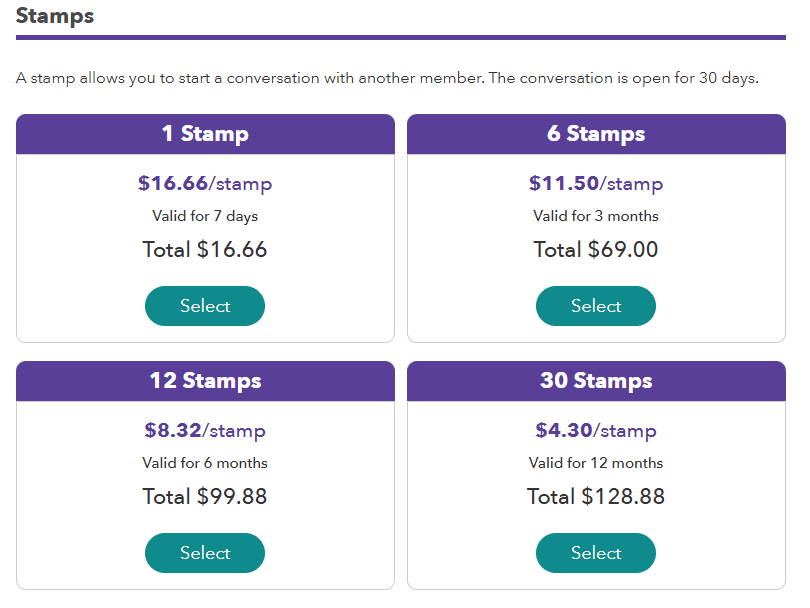
For most users, RSVP's entry cost is lower and the pricing structure is transparent. eHarmony's value proposition only holds if the algorithm produces better matches than you'd find browsing manually, and that claim is hard to verify when the test itself gets blocked before you reach any results.
How matching works
eHarmony
Before you see a single profile, eHarmony runs you through a compatibility questionnaire that takes roughly 10 minutes. It covers personality, values, lifestyle, and what you want in a partner. The platform then generates a set of daily matches based on that data. You don't search or browse freely. eHarmony decides who you see, and the theory is that this produces more compatible pairings than self-directed searching.
In practice, this means you are entirely dependent on the size of the AU user pool in your area. Sydney and Melbourne likely have enough volume for the algorithm to produce worthwhile matches. Outside those cities, the pool gets thin quickly. You also cannot contact anyone without a paid subscription, so the 10-minute quiz leads directly to a paywall with no meaningful free experience in between.
RSVP
RSVP is search-and-filter. You browse profiles directly, set your own criteria (age, location, relationship intent), and choose who to contact. A Wink is a free expression of interest that costs nothing and flags you to the other person. A Stamp initiates a conversation. RSVP does offer a “Who likes me” feature, but contact always goes through Stamps.
The Stamp gate functions as an intent filter in a way swiping doesn't. Paying to contact someone means both parties have committed something before the conversation starts. This is almost certainly why the response rate in our test (61%) was higher than on swipe-based apps. It's not that the people are better, it's that the economics of the platform screen out low-effort users.
30-day test results
Both platforms were tested using the same documented methodology: a real account set up in Melbourne, same profile photos, same bio, tested over a 30-day period in early 2026.
RSVP results
RSVP produced 43 matches over 30 days. I started 26 conversations using Stamps and got responses to 16 of them, a response rate of 61%. Browsing around 180 profiles, I flagged 4 as fake or suspicious. Support responded to a test query in 3 hours 40 minutes. These are the best response rate numbers I've recorded across any platform tested on SwipeReport. The match volume is lower than swipe apps, but the conversations that do start go somewhere more often.
eHarmony results
The eHarmony test was blocked at the age verification stage. eHarmony requires webcam-based identity verification before granting access to the platform. The verification process timed out twice at 15 minutes each attempt before a workaround was found. By the time the account was active, the test window had been significantly compressed. No match count, conversation rate, or response rate data is available for eHarmony from personal testing.
This is not a minor omission. It means the 52/100 score reflects the platform's setup friction, pricing transparency, UX, and safety features, but not verified match quality data. eHarmony's argument that its algorithm produces superior matches is one I cannot confirm or refute from first-hand testing. That alone is a material limitation when you're deciding whether to spend $299.40 on a 6-month plan.
Notable issues
eHarmony: ACCC action
The Australian Competition and Consumer Commission filed proceedings against eHarmony in 2024 over alleged misleading pricing and automatic renewal conduct. The core allegation is that the auto-renewal terms were not adequately disclosed at the point of purchase. Users report being charged for a 12-month renewal after completing a 6-month plan without understanding they had signed up for that. The cancellation steps described in eHarmony's own FAQ reportedly don't match what exists in the actual interface, with users redirected to email support instead. As of late 2025, you can deactivate your account but cannot delete it. The ACCC case is ongoing.
On ProductReview.com.au, eHarmony sits at 1.1 out of 5 from 1,968 reviews. That score is partly driven by the renewal complaints. It's the kind of signal that matters when you're committing to a 6 or 12-month subscription.
RSVP: Stamp pricing quirks
The single stamp option (1 stamp, $16.66, 7-day validity) is genuinely bad value and easy to stumble into if you're new to the platform. The per-stamp cost is twice the 12-pack rate and if you don't use it within a week, it's gone. RSVP presents all pack options on the same screen without flagging this difference clearly.
Stamps also expire when you cancel a subscription. If you've pre-bought stamps and then cancel your subscription, you lose unused credits with no refund. RSVP's Trustpilot score is 2.1 out of 5 (from a very thin sample of 13 reviews) and ProductReview carries complaints about this expiry behaviour. It's not as serious as eHarmony's ACCC situation, but it's worth knowing before you buy a bulk pack on the assumption you can use them later.
Which one is for you
Choose eHarmony if:
- You want the platform to curate matches for you rather than browse yourself
- You're in Sydney or Melbourne and want access to a large, compatibility-filtered pool
- You prefer paying a flat monthly fee to rationing per-conversation credits
- You're comfortable reading the full terms before subscribing, especially the auto-renewal clause
- The 10-minute onboarding quiz sounds like a feature, not a deterrent
Choose RSVP if:
- You want to browse and choose who you contact rather than wait for algorithm matches
- You're outside Sydney or Melbourne and need a platform with real regional presence
- You'd rather pay per conversation than commit to a 6 or 12-month subscription upfront
- You're 30 or older and looking for something more serious than swipe apps offer
- Transparent pricing and a clean cancellation process matter to you
Frequently asked questions
Is eHarmony or RSVP better?
For most Australians looking for a relationship, RSVP is the better starting point in 2026. It scored 74/100 in our 30-day test against eHarmony's 52/100. RSVP delivered 43 matches and a 61% response rate, while eHarmony's test was blocked entirely by an age verification paywall before we could reach any matches. That said, eHarmony's compatibility algorithm is a genuine differentiator for people who want the platform to do the work, provided they can get through setup and are willing to pay more upfront.
Is eHarmony worth it in Australia?
eHarmony is worth considering if you're serious about finding a long-term partner and you're in Sydney or Melbourne where the user pool is large enough for the algorithm to function. Outside major cities, the AU pool thins out quickly. The cost is high ($299.40 for 6 months minimum), the setup is slow, and the ACCC is currently suing eHarmony over misleading pricing and auto-renewal practices. On ProductReview.com.au, eHarmony sits at 1.1 out of 5 from 1,968 reviews. Go in with realistic expectations.
Is RSVP still a good dating site?
Yes, particularly for Australians aged 30 and over. RSVP has been running since 1997 and the Stamp model, where you pay per conversation rather than per month, filters out low-intent users in a way that swipe apps don't. Our test in Melbourne returned a 61% response rate, the highest across any platform we've tested. The interface is dated and the pricing structure is confusing on first visit, but the underlying match quality is solid. Fake profiles exist (we flagged 4 in roughly 180 browsed) but are lower than on most apps.
Which dating site is best for serious relationships in Australia?
Between these two, RSVP has the edge for serious relationships in Australia, largely because it's built for the Australian market rather than localised from a US product. The Stamp cost per conversation means people who contact you have actually committed something. eHarmony also targets serious relationships and the compatibility quiz is designed to match on values, not just photos, but the ACCC lawsuit and high cost work against it. For anyone over 35 outside the major cities, RSVP's deeper regional penetration makes it the practical choice.
How much does RSVP dating cost?
RSVP has two cost models. Stamps are per-conversation credits: a 12-pack costs $99.88 ($8.32 each, 6-month validity) and a 30-pack costs $128.88 ($4.30 each, 12-month validity). Single stamps cost $16.66 each with only a 7-day validity, making them the worst value option by a wide margin. Subscriptions run from $51.99 per month (1-month, includes 8 stamps) up to $22.25 per month ($266.99 billed annually, unlimited stamps). The 12-month subscription is the only tier where cost stops being a factor in how many people you contact.